Junk Removal Cost in 2026: What I Actually Charge and Why
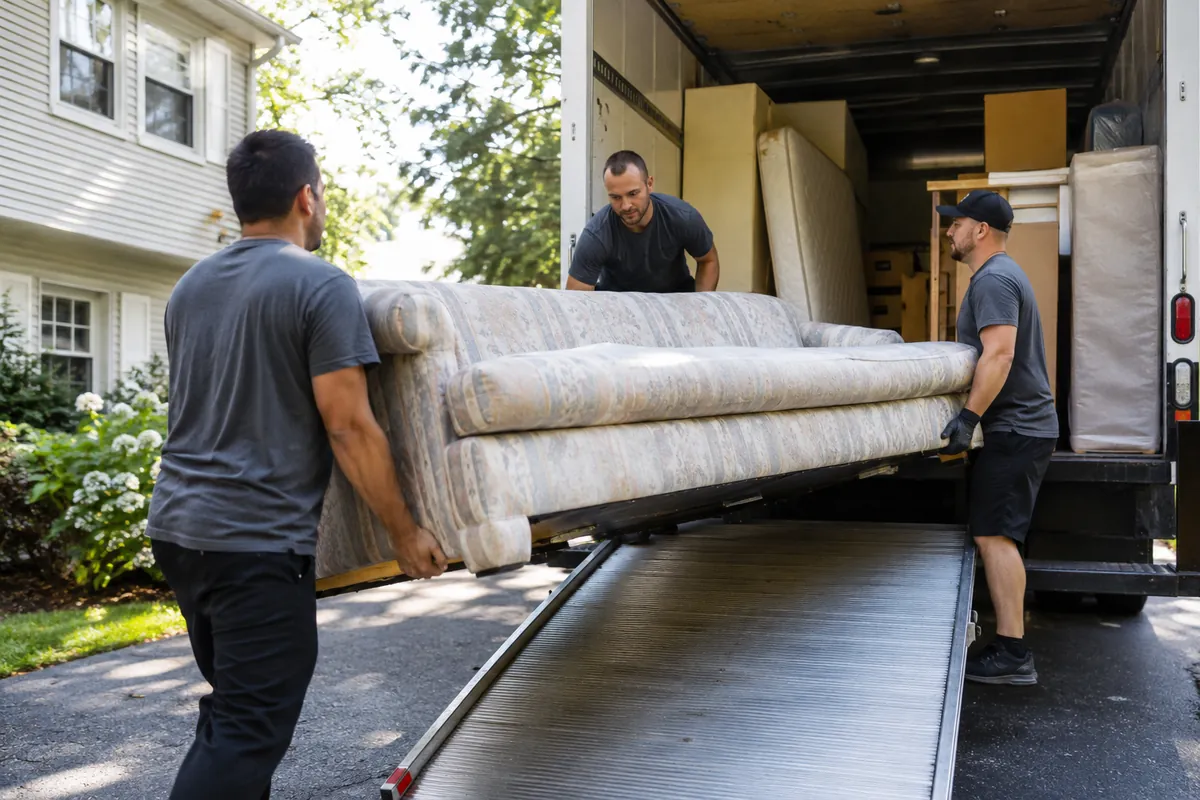
Junk removal cost: most jobs run between $150 and $600 in 2026, with the average single-pickup landing around $250 to $400. The price moves with how much space your stuff takes up in the truck, how heavy it is, what it is, and how far my guys have to carry it. I have been hauling for ten years, and the number that scares people the most, the dump fee, is the number that explains almost everything about how this gets priced.
Let me walk you through how I price a job, because once you see it from my side of the truck, the quote you get over the phone stops feeling like a mystery.
The four ways junk removal gets priced
There is no single formula across the industry. Most outfits, including mine, use one of these models depending on the job.
By volume (truckload fractions)
This is the most common model, and it is what the big franchises advertise. My truck bed holds about 15 cubic yards. I divide that into fractions, and you pay for the fraction you fill.
| Truck space filled | Rough volume | Typical price range |
|---|---|---|
| Minimum / single item | 1 item | $90 to $150 |
| 1/8 truck | ~2 cubic yards | $130 to $200 |
| 1/4 truck | ~4 cubic yards | $200 to $300 |
| 1/2 truck | ~7.5 cubic yards | $350 to $475 |
| 3/4 truck | ~11 cubic yards | $475 to $600 |
| Full truck | ~15 cubic yards | $550 to $750 |
Those ranges shift by city. A full truck in rural Ohio is cheaper than the same truck in San Francisco, and it is not because we are greedy on the coast. It is the dump. More on that in a minute.
By the single item
If you have one couch, one fridge, one treadmill, I quote a flat item price. This is usually the cheapest way to go if you genuinely have one thing. A single couch is often $90 to $175 picked up. The catch is the minimum. I cannot send a truck and two men out for $60, so even one small item hits the floor of my pricing.
By type of item
Some things cost more to get rid of regardless of size, because the disposal is special.
- Appliances with refrigerant (fridges, freezers, AC units, dehumidifiers): the refrigerant has to be reclaimed by law before the metal gets scrapped. Expect a $30 to $75 add-on per unit.
- Mattresses: many landfills ban them or charge extra, and recycling sites have their own gate fee. I usually add $25 to $60 per mattress. If you want the full breakdown on this one, I wrote a whole piece on how to dispose of a mattress.
- Hot tubs: these are a beast. They have to be cut apart, and they are heavy and full of old water and foam. A hot tub removal is rarely under $350 and can run past $800 depending on access.
- Construction and demolition debris: concrete, dirt, shingles, drywall. This stuff is dense, so it crushes your weight allowance fast. Priced by weight more than volume.
By weight
For heavy dense material, volume lies. A quarter truck of broken concrete weighs more than a full truck of cardboard, and the dump charges me by the ton. So for renovation debris I either quote by weight up front or I tell you straight that the dense load will price higher than the space it takes.
Why the dump fee runs the whole show
Here is the part most homeowners never see. When I leave your house, I do not get to drop your junk for free. I drive to a transfer station or landfill and pay a gate fee, almost always priced by the ton.
Depending on the region, I pay somewhere between $40 and $150 per ton to dump, and special items cost extra on top. A full truck might weigh two to four tons. That is $100 to $500 in dump fees alone before I have paid myself, my labor, fuel, insurance, or the truck payment.
This is the single biggest reason the same couch costs $90 in one city and $160 in another. It is not the couch. It is the gate fee at the dump nearest that couch. Cities with tight landfill space and high tipping fees push every hauler's price up, and there is nothing any of us can do about it.
It is also why I always sort. If I can pull metal out for the scrapyard (which pays me instead of charging me) or drop usable furniture at a donation center, my dump weight goes down and I can keep your price honest. That source-separation habit is the same waste-reduction approach the EPA's recycling program promotes, and a good hauler is quietly doing this math on every job.
Labor, stairs, and access
The other big lever is how hard it is to physically get the stuff out.
- Curbside or garage: cheapest. We back up, load, gone.
- Stairs: every flight adds time and risk. A piano or a sleeper sofa down three flights of a walk-up is a real workout, and I price for it.
- Long carries: if the truck cannot get within fifty feet, that is a longer haul per trip.
- Disassembly: if I have to take a bed frame, shed, or hot tub apart, that is labor time on the clock.
None of this is a scam. It is just the difference between a ten-minute job and a ninety-minute job for the same volume of stuff.
What you can handle yourself first
I will tell any homeowner this even though it costs me jobs: before you call anyone, see what you can divert. Sell what has value on marketplace, donate what a charity will take, and only pay to haul the true trash. If you are clearing a whole house of furniture, my guide on how to get rid of old furniture covers every free and paid route.
If you are running a long project, like a full renovation or a big garage cleanout over a couple of weeks, a junk removal service might be the wrong tool entirely. A rented dumpster could be cheaper. I broke that comparison down in dumpster rental versus junk removal.
For the small stuff you handle yourself, a few cheap tools save your back. A decent furniture dolly with straps lets one person move a fridge or dresser that would otherwise take two, and a box of contractor trash bags holds up to the sharp, heavy debris that splits regular kitchen bags.
Why the franchise costs more
People ask why the national-brand truck quotes $480 when my truck quotes $360 for the same pile. A few honest reasons:
- Overhead. The franchise pays royalties, national advertising fees, and a call center. That cost is baked into your quote.
- Flat-rate comfort. They price high on the front end so they are never underwater on a heavy load. You are partly paying for their margin of safety.
- Brand premium. A recognizable name on the door commands more, the same way it does in any business.
None of that makes them crooks. Their crews are usually insured, uniformed, and on time, and for some people that peace of mind is worth the extra hundred bucks. But if you call two or three local independents and get quotes, you will almost always find a fair price under the franchise number. Just confirm they are insured and that the dump fee is included, not a surprise line item.
How to get an honest quote and pay less
A few habits keep your bill fair:
- Get the quote in person or by photo, not blind over the phone. Any hauler who gives you a hard number sight-unseen is either guessing high to protect themselves or will surprise you with add-ons at the truck. I quote off photos or a quick look, then confirm on site.
- Ask if the dump fee is included. This is the line item that hides surprise charges. A quote that excludes disposal is not a real quote.
- Ask about the minimum. If you have one small item, the minimum may make a hauler the wrong choice versus bulk pickup. Know it up front.
- Pre-sort and pre-stage. If you carry everything to the garage or curb yourself, you cut my labor time and I can quote lower. The harder it is for my crew to reach, the more it costs.
- Divert the valuable and donatable stuff first so you are only paying to haul actual trash. Every piece you sell or donate is weight off the dump scale.
- Get two or three quotes from insured local haulers. Prices vary, and a quick comparison usually saves you fifty to a hundred bucks.
Frequently Asked Questions
How much does junk removal cost in 2026?
Most jobs run between $150 and $600, with the average single-pickup landing around $250 to $400. The price moves with how much truck space your stuff fills, how heavy it is, what it is, and how far the crew has to carry it. The biggest swing between cities is the local dump fee, not the hauler being greedy.
How is junk removal priced?
The most common model is by volume, where you pay for the fraction of the truck your stuff fills, from a single-item minimum up to a full truckload. Haulers also price by the single item, by item type for things with special disposal, and by weight for dense debris. Many jobs use a blend, and dense material is always priced more by weight than space.
Why does junk removal seem expensive?
Because the hauler does not get to throw your junk away for free. Every load goes to a transfer station or landfill that charges by the ton, commonly $40 to $150, plus surcharges on appliances, mattresses, and tires. A full truck can cost $100 to $500 in dump fees alone before the hauler has paid for labor, fuel, insurance, or the truck.
Why does the same item cost more in one city than another?
It is the gate fee at the dump nearest that item, not the item itself. Cities with tight landfill space and high tipping fees push every hauler's price up, and there is nothing any of them can do about it. That is why the same couch can be $90 in one city and $160 in another.
How can I lower my junk removal bill?
Divert the valuable and donatable stuff first so you are only paying to haul actual trash, since every piece you sell or donate is weight off the dump scale. Pre-sort and pre-stage items at the curb or garage to cut the crew's labor time, ask whether the dump fee is included, and get two or three quotes from insured local haulers. That comparison alone usually saves fifty to a hundred bucks.
Why does a national franchise cost more than a local hauler?
Franchises carry overhead that a local independent does not: royalties, national advertising fees, and a call center, all baked into your quote. They also price high on the front end to stay safe on heavy loads, and a recognizable brand commands a premium. None of that makes them crooks, but calling two or three insured local independents will almost always find a fair price under the franchise number.
The honest bottom line
Most junk removal in 2026 lands between $150 and $600, the dump fee is the engine behind every quote, and the price is driven by volume, weight, item type, and how hard your stuff is to carry out. Before you pay to haul anything, divert what you can sell or donate, get two or three quotes from insured local haulers, and make sure the disposal fee is baked in. Do that and you will pay a fair number instead of a padded one. If you happen to be on the other side of this and thinking about doing the hauling yourself, my guide to starting a junk removal business lays out exactly what the numbers look like from inside the truck.